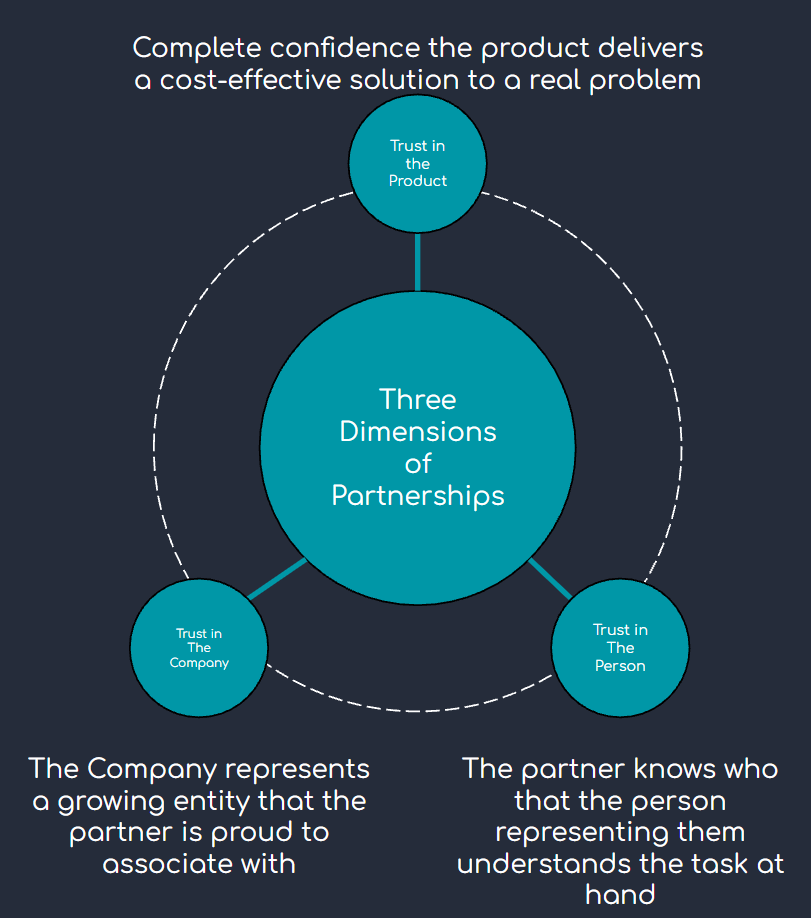
I've spent the better part of a decade building partnerships. Enterprise accounts, global retailers, SaaS businesses, organisations genuinely trying to solve hard problems with the right technology.
And across all of it, I keep coming back to the same three questions.
Not as a checklist. More as a gut check. Because when a partnership stalls, when a deal that should close doesn't, when a renewal that felt certain suddenly feels uncertain, the answer is almost always sitting in one of these three places.
Does your partner trust the product?
When all is said and done, does your champion actually think the product is a good idea? Not just on paper. In their gut. Because at some point they're going to have to walk into a room and sell it upwards. To a colleague, a CFO, a board. And if they don't believe in it themselves, that conversation isn't going to go well.
A champion who believes in the product finds a way to move things forward. One who doesn't finds reasons why they can't.
Here's the thing about objections. When a partner says they need to talk to someone else before moving forward, that's rarely a process issue. It's a trust issue.
The product dimension is about whether what you're selling is genuinely a good idea for them. If the answer is yes, almost everything else becomes easier.
Does your partner trust you?
This one is built, not assumed. And it needs to be built early.
The fastest way to establish credibility in a new partnership is to understand someone's pain and resolve it as quickly as possible. Not promise to resolve it. Actually resolve it. Even something small, answered quickly and without fuss, tells a partner more about who you are than any credentials or case studies you could put in front of them.
And if their first concern is that they don't know you at all, then that's where you start. You tell them who you are. You state your intent clearly and you follow through on it. Credibility compounds over time, but the foundation has to be laid in the first few conversations.
Does your partner trust the company?
This is the hardest dimension to control and the easiest to underestimate.
Partners don't just buy a product and a relationship with you. They buy into an organisation. Its direction, its values, how it makes decisions when things get hard.
And this is where I want to challenge anyone reading this who works in partnerships or customer success. The standards you walk past are the standards you accept. If your company is making decisions that let your partners down, decisions that you know aren't right for the customer, you have both the standing and the responsibility to say so. Internally, clearly, and without apology.
That's not disloyalty. That's the job. Your partners are trusting you to represent their interests as much as your company's. If those two things are out of alignment, someone needs to say it out loud.
Three dimensions. Product, person, company. You don't need perfect scores across all three, but you need a positive answer in each one. One weak dimension can be managed. Two makes everything harder than it needs to be.
This is the framework I come back to whenever something feels stuck. It usually tells me where to look.